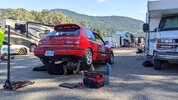
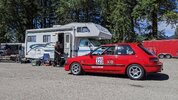
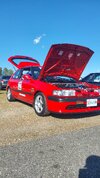
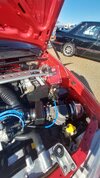
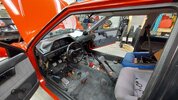
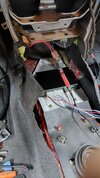
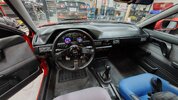
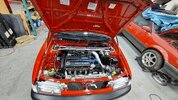
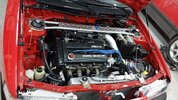
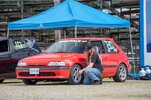
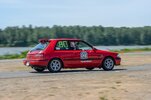
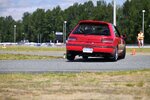
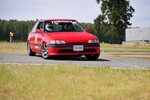
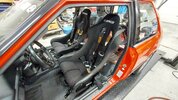
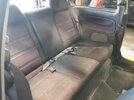
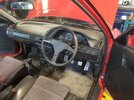
"Princess" A Mazda 323 like no other.

With that much spring in the rear, for such a lightweight car, plus the trailing arm with that wide poly bushing, how much passive steering do you plan to use?

You may not get that much flex, and not need to worry about it with this current set up.
The passive steer isn't coming from bushing flex. With heim joints and polly bushings, there isn't really any flex. The passive rear steer is a function of the arcs the lateral links and trailing arm move in and how it dynamically shifts things. My goal is to dial out the passive rear steer and hopefully make the car rotate better.

The increase in rear spring should allow me to run my rear shocks and rear bar on softer settings and give myself some adjust ability. I was running with the rear bar and shocks pretty much full stiff last year.
 
@phate i found you a friend

Yays.


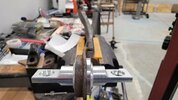
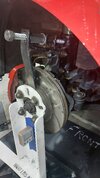
Next up.. Bump steer. Using my laser level and work bench, I marked where the laser hit my bench. From there I cycled from full droop to full compression. Once done, that high school math you never thought I'd used comes into play. I measured the distance from the marks to the laser. Then measured the distance between the marks. From there you can math out how many degree of movement you have. In my case it's about 1.7 deg of toe change.. specifically toeing out. This makes sense, some toe out during bump is going to induce some understeer. Manufactures want a car to have more understeer characteristics for safety.
View attachment 34267

That's all for now. I've gotta come up with an excel sheet in order to track all of this.

Nice thread! Not many people go through the effort to measure all of this but it really helps in understanding where not to set things. Where to set things is forever a subject of debate and ever flawed data analysis (lol).

I will say that measuring bump steer like this can be done, but you have to account for scrub (change in lateral position of the wheel surface). You can severely influence bump steer curves when you don't. An alternative way to measure that cuts the error down by a factor of ~300:

 
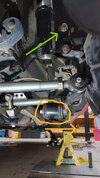
Camber set aside lets look at a different aspect. The rear suspension of these cars is known to have what's called "passive rear steer". This means the rear tires turn slightly as the suspension moves. I've never measured this or looked closely at it. It's been assumed that it helps the car rotate when turning. It's also been theorized the bushings helped with this. Non of that is the case. As the suspension moves up, the trailing arm moves through an arc that pushes the knuckle backwards slightly. This shifts the lateral link alignment, causing the rear to toe in for more stability. I have a plan to relocate the front of the trailing arm with the hopes of eliminating this.


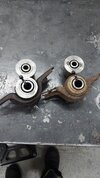
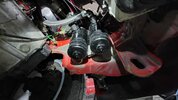
I am running into another problem. It's the reason why I don't like Poly bushings. In order to get rear camber I have tilt the knuckle in. When doing this it twists the trailing arm. Well the bushings don't like this. It's causing them to bind up. For this season it is what it is, but in the future I've got to find a way to get a spherical bearing in the front to allow the arm to twist and move smoothly.

View attachment 34335


For the passive steer in the rear, it's worth considering what happens when the system sees that lateral load and how different bushings stiffness can influence that behavior. It comes from both geometry changes and bushing deflection. It may do something in the air on stands that could be changed drastically with some bushing deflection.


On the trailing arm side of things - what does that forward mount look like? I converted to sphericals several years ago in the 6 and did this for the trailing arm:

20b525fd-f2bb-44a2-87c8-f07348dd8e02.jpg
 
Yays.


Nice thread! Not many people go through the effort to measure all of this but it really helps in understanding where not to set things. Where to set things is forever a subject of debate and ever flawed data analysis (lol).

I will say that measuring bump steer like this can be done, but you have to account for scrub (change in lateral position of the wheel surface). You can severely influence bump steer curves when you don't. An alternative way to measure that cuts the error down by a factor of ~300:


Thank you for that video. I haven't see bump steer measured that way before. I'll have to try it and compare my results. All though I am in the process of screwing up all my testing data. I have some spherical bearings to install in the front control arms. These came off my old SMF car. I've got adjustment in the rear bracket, plus the rear bushing being off set, and some planned modifications to the front control arms, I am hoping to gain another 3 deg of castor.

20260411_211926.jpg

The front bushing for the trailing arm will be fairly easy to convert to a spherical bearing. I just need a friend with a lathe and some time.

20260411_204543.jpg

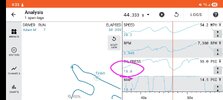
With heim joints in my lateral links the only bushing flex I have is the poly bushings in the trailing arms. A long time ago I took a video of my rear suspension during an autocross run. I don't remember seeing anything going on that makes me worried about bushing flex in the trailing arms.


The issue I do have with the trailing arm is trying to get camber. The upper bolt is slotted for camber. This twists the trailing arm as the bottom mount moves outwards. As we know, polly bushings hate being misaligned. 20260411_204748 copy.jpg
 
I wish I had a CNC machine or mill. I've got a custom throttle body adapter to build in order to make an ND2 throttle body fit. This will give me a proper IAC valve. I wont have to fight with tuning around the stock coolant controled high idle valve and "Idle up" valve that's not really designed to be modulated by a stand alone ECU. All though you can do it and it works. I've found cold start tuning tricky to get right. You can't really anticipate the high idle valve and how quickly it closes and when you need the idle up valve to start taking over.

Shameless plug here - I make custom parts and focus on the racing community for projects like this. I've made some pretty nutso complicated TB adapters with bent passages and ORB ports and whatnot, and I've even made some IAC housings recently. Prototypes, one-offs, and small runs of parts are what I do.

I had a thread like this on MSF (rip) with all the suspension data for the MS6. I also went through spring and bar math for setting up a car by the numbers, and replicated that over here when MSO went live. Link.

My MS6 has been in ESP for ~10 years now. We (my wife and I) campaigned it nationally with pretty good success. I've been 2nd at nationals in ESP once or twice, won several tours, and indexed as high as 11th at nationals. We took last year off since we had a baby, but should be back out at some point this year if things go well.
 
Shameless plug here - I make custom parts and focus on the racing community for projects like this. I've made some pretty nutso complicated TB adapters with bent passages and ORB ports and whatnot, and I've even made some IAC housings recently. Prototypes, one-offs, and small runs of parts are what I do.

I had a thread like this on MSF (rip) with all the suspension data for the MS6. I also went through spring and bar math for setting up a car by the numbers, and replicated that over here when MSO went live. Link.

My MS6 has been in ESP for ~10 years now. We (my wife and I) campaigned it nationally with pretty good success. I've been 2nd at nationals in ESP once or twice, won several tours, and indexed as high as 11th at nationals. We took last year off since we had a baby, but should be back out at some point this year if things go well.
I appreciate the offer. I've been slowly learning how to do 3d modelling in order to have a file that I could send to someone like yourself. I am not there yet but I'll keep you mind when I do. I remember hearing about your early success and started following what you were doing quite a while ago. I appreciate having you coming in and passing along some of your thoughts and knowledge. I read through your thread a long time ago, a lot of it was way over my head back then. I am starting to grasp more of it now.

Justin Brabry did an extensive FSP build back in the day on a Protege. It's been retired from autocross to track duty. I used a lot of what he was doing as a frame work 10+ years ago.

It's interesting when you talk about roll bias, This has been talked about as front and rear roll stiffness to me. Despite some of the math I've been doing with tuning my Speed 6, doing motion ratio calculations, sway bar calculations ect is a bit beyond me for now. I think I understand most of the concepts.

For anyone interested. He's a fun video of the LF suspension and tire in action. If you watch it close enough you'll see the front control arm mounting point flexing. That's the sub frame flexing, not bushing flex. I had the solid spherical bearings previously posted installed at that point. This car eventually got a 2 point brace to help fix that. Princess has a 4 point brace.


Another old video. This one is the rear suspension. I have the same lateral links with heim joints here. But I am running stock trailing arm bushings. You don't get a good shot of what the trailing arm is doing. If it's flexing back and forth. but it's a fun video to watch. Plus both videos you get to hear the glorious sounds a 2.5L KL V6 makes as it's revving out. The 1.8L V6 versions in the Mx3 were known for the amazing exhaust sounds.

 
Back
Top