Nasty misfire with high LTFT, worse at cold start w/ logs

jonjon

Greenie N00B Member
Year/Make/Model: 2013 Mazdaspeed3
Mileage: ~165000
Location:
Phoenix, AZ
Concern:
Nasty misfire with a high LTFT
DTC's:
P0300, P0303, (inconsistent) P2096
Modifications:
CS turbo inlet pipe, race pipe, CS HPFP internals
ECU/Tuning Software:
Versatuner
Tuner:
N/A
Is the concern intermittent?
The LTFT DTC is intermittent but the misfire is constant
Can you duplicate the concern?
Yes
Recent Repairs:
Changed spark plugs, moved around coils, swapped different wideband O2 sensor, checked for boost and exhaust leaks (none), compression test (~180 across the board),

Hi everyone, my speed recently began to misfire pretty badly. I was sitting on CS HPFP internals and a rebuild kit which I threw into the car to maybe alleviate the problem but there was no change. Prior to the misfires the LTFT was beginning to climb higher and over a several week period. I have taken many data logs where the AFR is ~14.3 but the ECU is still maintain a high LTFT of 10+. I have taken a look at both potentially vacuum leaks and ignition problems but to my eye, I have no leaks and swapping plugs and the coils around did not change the misfire behavior. I did manage to borrow different wideband sensor from someone off my local Facebook group but swapping that in did not change the behavior either. In retrospect, I did forget to unplug the battery during that swap but I did go for a short drive and took logs.

I am currently suspicious of the PRV (I did the test and it only climbed to around 1200psi but my fuel pressure which driving and at idle appear fine), the HPFP spill valve (during the rebuild, it felt as through it was seized to the housing and took an incredible amount of force to remove it from the threaded housing, I only replace the O-ring in accordance to the CS video and did not directly clean the spill valve solenoid(?)), O2 sensors (the AFR doesn't look ideal but maybe the car runs extra rich with the DTCs to protect itself?), MAF (I checked the wiring and cleaned it but maybe its the problem causing the AFR issues?)

I have a bunch of logs that I took but to my unexperienced eye, I have no idea where to take a deeper look. Thanks to anyone willing to take a look at these logs and maybe give me a suggestion at where to maybe start probing to get a better diagnosis.

NOTE: The log with the "new" O2 sensor was started when the car was cold to maybe record anomalous behavior from the car being in open-loop. The mods excluding the CS HPFP internals were on the car for months before the symptoms began.
 

Attachments

Couple things:
1. Who is the tuner?
2. What are the DTC definitions (don't make others look this up for you)
3. What, if anything, has changed since just before having this issue?
4. What fuel are you running? E mix? Pump gas?
5. What intake do you have? Does it have an airflow straightener?
6. At idle, remove the air filter (or rotate it 90 degrees if cone filter) and see if the trims change
7. Try clamping the evap line and see if the trims change (this is the hose near the HPFP with the inline filter disk; just start the car, start a log and pinch it off to prevent flow through and see if the AFR or trims change when you pinched it). Most likely, if this is the issue, you will hear the engine idle change when you do this if this is the cause.
8. Wiggle the MAF wires at idle and see if the engine sound changes. If it does, you may need to cut out and replace the MAF connector (I needed this on my car).

The logs just look like you either need a mafcal or maybe fixed a vacuum leak that was tuned around previously.
 
1. No one, if the car is tuned it was before I purchased it (auction), I just assume the tune is stock. The race pipe was on there originally and the CS turbo inlet pipe thrown in because the OEM one had a vacuum leak. I only used Versatuner free for the data logging features.
2. P0300: random misfire, P03003: cylinder 3 misfire, P2096: post catalyst system fuel trim too lean (bank 1)
3. Before the problem, the most recent thing I swapped out was the turbo inlet pipe for the reason above. Initially before and after this change my LTFT was sitting around +5.
4. Pump gas, 91 octane is all we got readily available in Phoenix.
5. Stock air box
6. I will try this in the next day or so
7. I will also try this and create an update here
8. I did attempt this some time ago and wiggling the wires did not change the engine sound but I will try again a little more vigorously

I would be surprised in regards to a mafcal as that part of the intake is completely stock. The screws that hold down the MAF are a little loose but it appears to sit and seal properly
 
With the stock intake, replacing the air filter if it looks dirty would be a good idea. The stock straightener is meh, but the intake itself is so small diameter this shouldn't be the issue (unless the air filter is so heavily dirtied to one side that its causing reading errors at the maf).

Also, the misfires could be because of a lean or rich condition, so it's entirely possible that fixing the fueling/air issue will also fix the misfires.

On second thought, another quick high priority test you should do is to disconnect the hose going from the turbo inlet (cap/plug the inlet port) to the valve cover and see if there is smoke coming out of the valve cover or if it's drawing vacuum.

If smoke is coming out at idle or it's not pulling vacuum, chances are good you've lost some ringlands and that's why the car went to auction, for whatever reason.
 
Keep in mind the engine has to be HOT for that test to work properly. I saw some 1600s in one of the logs and the throttle wasn't even WOT; I'm less worried about the PRV at this point.
 
Alright, I did all the "tests" minus the PRV one (I have a couple questions about it). So kinda going in order:

1. Removing the air filter: This did not make a change in the fuel trims to my eye. The LTFT was floating around +14 and did not change before and after
2. Clamping the evap hose: There was no change in the idle with it connected nor plugged
3. Wiggling MAF wires: No change
4. Checking valve cover vent: There was a little bit of vacuum and no smoke (it was hard to tell if there was vacuum but holding a tissue paper to the port, it was gently being sucked into it). I did expect this since my motor's compression is pretty good

I also tried just unplugging the MAF which did mess up the AFR but after an initial stumble (outside the misfiring) the car basically ran the same as it did plugged in. In regards to the PRV, should the test be consistently repeatable? Like if I were to get the car hot (~170 from just idling) and let the fuel pressure rise, could I then repeat this by running the car for some time to rebuild the pressure and get hot again to then let the fuel pressure build when off? I ask because I attempted this and after the initial pressure climb and restarting the process to get another measurement, the fuel pressure would refuse to build at all and just drop.

I did already buy a PRV some time ago when I noticed this (I got a pretty good price for an OE one) and I'm going to just go ahead and throw it into the car and see what changes.

Thank you guys for helping me out! Are there any other tests I should do? Any other places that I should potentially look at? I am now thinking of maybe trying to borrow a MAF and see where that goes.
 
The PRV test can be tricky. The engine needs to be HOT hot, so not just getting it up to temp via idle. Take it out and put some load on it, then when you park it, shut it off just as you blip the throttle (to command higher rail pressure) and THEN KOEO to see what it climbs to. Ideally, it will be hot enough to have the radiator fan want to kick on, since this heat is what will build pressure in the rail to test the PRV with. Aside from that, not getting super high pressures during cruise isn't always going to be wrong, depending on the tune.

As far as the other tests go:

1. Kinda expected, since it's a stock airbox, but easy enough to try so worth testing.
2. I am assuming you disconnected the evap hose and put a finger over it, correct?
3. Good.
4. Normally, you'd just use a finger over the hole to see if it is pulling against your finger or not, since that's easy to tell suck vs blow and it can't pull enough vacuum to hurt you; only risk here is it being super duper hot, but this test can be performed on a cold start so that shouldn't be a concern. If this were blowing gas/smoke/air out, then your rings or lands or a piston would be shot.

As for the trims, the STFT needs to be looked at as well, since the LTFT won't change immediately; this is why I said "trims" (plural) vs just "LTFT."
Short term trims will change quicker, but if you're doing these kinds of tests, its generally worth logging because you will see a sudden bump in AFR, trims or other cell values to know that something you did had an impact.

MAF swap and/or cleaning could help. Could also maybe unplug the secondary (narrowband) 02 sensor, which has its clip buried on the top back of the transmission near/under the inlet. Sometimes these can go out in a weird way that causes offset issues with the wideband. Personally, I don't run a narrow anymore at all.
 
So I did swap in the new PRV and clean the spill valve with no change in the motor's behavior. I also did unplug the secondary O2 sensor as you mentioned and that also did not change anything unfortunately. Something to note though is that a DTC never came up for the O2 sensor being unplugged and I probably had the car running for around ~10 minutes. I am scared to drive it with the cylinder 3 misfire as to cause permanent damage to the cylinder. I'll go find a MAF to borrow but after that I am totally at a loss.
 
I think I found my problem finally... I was checking for any damaged conductors as previously I have to replace a pin in a connect for the fuel pressure sensor. I double checked my repair and the resistance was reading the value I was expecting. But somehow after unplugging and replugging in connectors and starting the car, my fuel pressure was reading incredibly low. At idle it was at around ~90psi and at a low RPM cruise it was sitting around ~250psi. I checked the KOEO fuel pressure to 'test' the in-tank fuel pump and it would sit around ~75psi. So I am assuming the fuel pressure sensor is probably fine? That is then leading me to the HPFP as that is what I touched last, but the misfiring symptom was happening before I did the HPFP rebuild. Any suggestions for next steps? Is there a way for me to test my HPFP?
 

Attachments

The car should struggle hard to start if the pressure is actually this low. It can run and be drivable with low pressure like this, but it won't run well and you won't be able to give it much pedal before it starts breaking up/misfiring.

If it fires up just fine and you can blip the throttle and it revs just fine, it *probably* isn't the HPFP.

In fact, judging by the IDCs compared to the rail pressure and trims, I'd have to say that the rail pressure sensor isn't reading right. At this low of a pressure, I'm fairly certain it would take more than .9% duty cycle to push enough fuel for idle.

Can you get the car idling then disconnect the spill valve? if that changes the idle when its reading low pressure (and you stop hearing a click from the HPFP), then you know it's likely not the pump.
 
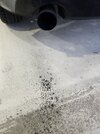
I just did your suggestion of unplugging the spill valve as the car idles and while the ticking from it does stop with it unplugged, there was no change in the idle noise or fuel pressure. It just floats around ~90 psi. So the spill valve is my smoking gun? And while the car does rev some and idle it is not fine at all, it is missing constantly and running very poorly. It's not totally falling flat and dying but it sounds like crap. Also it's spewing a ton of water and soot, I assume from running very rich. Here is a picture of what the motor is coughing out intermittently:
 

Attachments

  • 20260304_183458.jpg
    20260304_183458.jpg
    2.3 MB · Views: 1
Water and soot is normal for pump gas. There's probably a fair bit of humidity in the air, and the exhaust pipes will be cool initially, causing condensation inside that sprays out the back. This should stop once it heats up.

And yeah, it's likely there's something going on in the HPFP at this point; take it off and clean it with lighter fluid (naphtha if you'd rather buy in bulk from a hardware store) and then lubricate with Redline Injector cleaner.
 
Back
Top