Signs of excessive backpressure?

I have checked cam and crank timing, all are together at TDC so unsure on that one. I have had a time where I have accidently ran up to 115% IDC and she was quick and with no misfire but I never try to go above 100% IDC.

I'm on LTR7IX-11 gapped to 0.026 inches, so I'd like to think it isn't a spark issue, because then again it is always at high RPMs. I will say I still feel like the car falls off above 6500RPM or so, despite since doing a full 3" exhaust, so maybe there is another issue going on that I am not aware of yet.

Could it be something to do with stock valves and springs becoming lazy at high rpm high boost, or would the valves probably had hit the pistons by now?
 
Power is probably falling off because you have no timing. At ~6k, most tuners have pump gas at or near 14 degrees, and det-free corn mixes around 20, iirc.
 
Oh wow, I have never gone near 14 degrees at 6k. I know it may vary, but do you have a rough idea of what sort of timing on 98 octane you would expect to see? I peak around 2.6 load at 4500RPM and near 2.0-2.1 load at 7000RPM.

Also, what is expected battery voltage on the MPS 6? I have noticed my dipping around 13.2V at times and sitting around 13.6V when cruising. I recall my MPS 3 being almost always at 14V.
 
Depends on the car. Also, this will change your position on the chart.

Don't worry about the battery voltage; the ECU will adjust it as needed. As long as it's above 13v when running, you're probably fine.

Edit: If you're worried about battery/alt health, most car parts places will test both for free, right in the parking lot.
 
Okay, so I could probably lower load slightly to give some fuel headroom and increase timing.

Good point, I didn’t even think about that haha.
 
My understanding is that DI platforms tend to benefit more from timing than AFR vs PI platforms. Adding a degree or two should net some impressive gains.

For example, I was running in excess of 30 degrees @ 8k RPM.

Also, as a side note, I've been thinking that the 14 degrees might be at 6500 RPM and not 6K; it's been a while since I've done any tuning, so just be careful.
 
Okay that is interesting, maybe I will richen AFRs a bit closer to 11.0-11.2 by redline and increase timing and see how it goes.

On pump I really should be knock limited before MBT?
 
I started increasing timing, especially from 6000RPM and up and I'm surprised with the difference, fairly night and day as it actually wants to rev out to redline.

Currently I am | 3* at 4.5k | 5* at 5k | 7.5* at 5.5k | 9.5* at 6k | 11* at 6.5k | 12* at 7k | 13* at 7.5k | and I have had no reported knock yet. Later tonight I will go out again and see if I can keep increasing them, especially above 6k.
 
Once you find MBT, back it down about 15% on the timing for safety. 20% would be better, but if you have enough cooling and/or knock resistance, less would be fine. Also, maybe adjust your safety tables for timing and boost as well.
 
Alright sweet.

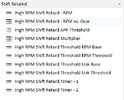
On a side note, do you know much about the 'Shift Related' section in VersaTuner? I believe I have disabled all related shift cuts in it but I wasn't sure if there was a purpose or benefit to it, if I should leave it stock or if there was a way that you can make it pull timing into negatives when shifting?

1787744243911.png

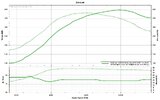
Edit: So this is what I have ended up with so far, you can see the drop that I am talking about which is a little annoying but I think this is the most I can safely extract from the stock fuel system. Don't get me wrong, the car feels fast and is solid to drive but you can feel the power drop in the higher RPMs sadly which is where it starts to get fun.

1787756625585.jpeg
 
Last edited:
Can you graph your timing in VD or post a log? Curious to see if you are scaled smoothly or if you're just running into reversion (if mostly stock exhaust setup, it's probably reversion, esp at 36 PSI.

Also your power for 36 PSI should probably be higher than 400 on dynojet, unless you're at elevation. Change scaling to 1.01 smoothing 3, as that's more accurate to realistic road numbers (dynos can read whatever you want them to, so are only good for comparing vs earlier/later dyno numbers and/or dick swinging).
 
The exhaust setup exactly after the turbo (which is 3" v-band) goes 3" downpipe with 2x 200 cell high flow cats, one just after the turbo and one near the cat back connection and then 3" all the way to the rear with a straight through resonator and a straight through muffler. The only part I could think would be a restriction are the 200 cell cats but I would assume they won't be an issue at such power level?

Also, this is absolute manifold pressure so you have to minus 14.8 because that is my barometric pressure. I normally use the dyno jet setting because I'd rather over estimate my torque than under estimate because I don't want to push the car too hard.

In the log it is worth noting that from around 6000RPM the airflow stays relatively the same and that lines up with the dyno where it falls off after 6000RPM.

Are the stock cams possibly the restriction here?
 

Attachments

First off, your WGDC is falling as RPM increases. As RPM goes up, potential airflow does too, so having reduction in commanded energy to the turbo is obviously going to reduce overall flow from the turbo. Even though the reduction in boost is minimal, think about how much air is trying to flow at higher RPMs and how much air in grams per second just a few PSI would actually be at 6500 RPM.

Secondly, some issues with your logs.
I've probably already said this in this thread, but there's nothing you can gain from logging absolute pressure over actual measured boost pressure (unless you get satisfaction from having to do math every time). You can log it, but also log straight boost for people who actually want to know where your turbo might be efficiency and flow wise. I think you can also log Baro directly, but it's been a while and I don't recall.

Also, don't log actual throttle position unless you're troubleshooting something. The car is drive by wire, so you're seeing only what the ECU wants to do throughout the log instead of what you're actually telling it to do. Log pedal position instead.

Once more, timing may be an issue here up top. With the stock 1.6 rod ratio, piston speeds tend to get super nasty past 5500 RPM, and thus each point of timing does less and less, and you start needing more and more.

As for the reversion question, another factor is the AR of your turbocharger. Smaller AR turbos don't run as well up top as bigger ones; the tradeoff being smaller AR turbos tend to spool faster.

As for cams, yes, stock camshafts are profiled for ~3-5k RPM powerband, with the capability to push a little past that. Stock turbo cars fall on their face at 5750 ish, but I don't recall what big turbo stock cam cars normally fall off at.

Exhaust will be fine for your power levels; that shouldn't be the issue unless the cats are clogging (which can happen with shit gas or running way too rich).
 
The WGDC is falling as RPM increase to maintain the boost pressure needed to get the desired load target. My load targets are already bringing my IDC close to the limit so I can't really go any more.

Yeah I will remember to add boost pressure next time.

I have always logged actual throttle position to know if the throttle was closing, but this never really is an issue so I can change it.

With timing, are you suggesting that I am increasing too far or I haven't increased enough?

The turbo is on a 0.82A/R, which is the same as a BNR S6. Being a G30-770, I am closer to choking the turbo than over spinning it at this power.

In saying this, I think the power drop may be related by a combination of things like the stock cams, the boost dropping to not overshoot IDC and not having anymore headroom to flow anymore, essentially I have maxed out this fuel setup.

But what still has me lost, is this misfire I get from time to time at high rpms, I have blamed it on IDC all this time but maybe there is a chance it isn't IDCs because it doesn't make sense to misfire around 100% IDC. I have noticed when getting around this exact range of 6400-7200RPM that it feels a little rough. I'm on 1 step colder plugs, but is that necessary for my setup? I believe I gapped my plugs to 0.026".

Edit: When you get misfires due to high IDC, what do you see in the data log? Lean AFRs?
 
Last edited:
I'm not sure what the exact criteria is for needing step colder plugs, but I do know you don't need them on low power setups and should avoid using them when on det free corn mixes, as they can cause this exact issue with misfiring.

As for IDCs, I don't recall if I mentioned this, but I've seen full corn cars start having issues around 105%, while I've also seen a pump gas only car at around 150% (don't try this yourself, it was a test and super risky). The main difference between those is how much timing you add.

Since you brought it up, maybe your next test should be stock heat range plugs with no changes to the current map...See how that goes and if it changes your power curve at all.
 
My understanding was for every 100hp or so over stock power, you should go a step colder.

I also assumed because Cork Sport sells the exact step colder plugs pre-gapped and they say its good for stock power up to 450hp.
 
Every setup is different though, and if you have misfires up top, that would absolutely explain the power drop.

Plus there's a lot of counterfeit iridium plugs running around these days.
 
Back
Top