Signs of excessive backpressure?

So to add onto the confusion, I was playing with my WGDC and went a bit over the top, it made 24.5-25psi near redline and IDCs were about 110% and not a single hesitation... and it was fast.

If I am being honest, it seems to be a hit or miss kind of thing and I think I am looking in the wrong areas, I don't think it is a tune related issue. I bought this car not running and had been sitting for about 3-4 years so I think it could be maybe a bad ground, wiring or something that is unrelated to the engine.

Do you guys have any ideas of things I could check in terms of wiring / grounding on a MPS 6?

Maybe crankshaft or camshaft position sensor, is there a certain distance the crankshaft sensor is to be from the harmonic balancer cogs?

Edit: Not sure if this matters but I pulled the motor and accessories from a Mazda 3 MPS BK. I assume the parts can be transferred across with no problem?
 
Last edited:
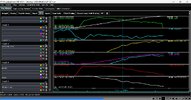
When I zoom in on the upper end of your log. I see a fair amount of injector Duty cycle instability. Versatuner has a very slow logging rate, which means this is averaged out quite a bit.. There's a good chance it's a lot worse.
Brandon log.jpg

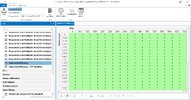
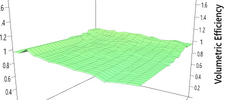
The ECU takes the MAF signal as it's starting point for calculating fueling. The VE table get's factored in later on. You've blanked yours out killing this part of the calculations. Brandon Volumetric.jpg

Try putting the VE Tables back to stock. This will screw up your MAF cal, you'll need to retune it. Once you get the AFR's close again, try using the VE table to smooth them up. It's been so long since I've played with the VE table, I forget if going up in value adds fuel or takes it away.

Also try lowering you base duty cycle table. This will let you lean more heavily on the load and boost correction tables to get you up to your targets. This should make things a little softer when it comes to the oscillation in the MAF/MAP and Waste gate we see in the logs.
 
Lol shouldn't touch the VE table, that's for sure.

I think you should probably just start over on your map (if you're self tuning). Start with a clean base map, do the bare minimum to get it running (like transfering over your existing MAFCAL), and go from there.
 
I will revert the VE back to stock, but with it set to stock the AFRs were way less consistent and the MAF calibration was jumpy to get it on target. The only difference I noticed having it set to 1 was the mass airflow g/s parameter read lower than normal, load was still the same and it had a clean / smooth MAF calibration that was consistent.

Also as for the load cut limits, it is only close near 4500 and 5000 RPM, where torque / load is quite high so I'd rather have that protection there, besides if you have ever gone over this set number it doesn't cut instantly, rather it has a delay and then will cut if you haven't dropped below. So if I ever spiked over 2.6, which I never do, it'll have to be for a period of time to take effect.

I will revert the VE back to stock (and retune MAF calibration) and see if that changes anything.

Edit: I have a Mazda 3 MPS Gen2 (BL) motor in my car, does it make sense to use the VE table from the Gen2 MPS or stay with the MPS 6 version?
 
Last edited:
I will revert the VE back to stock, but with it set to stock the AFRs were way less consistent and the MAF calibration was jumpy to get it on target. The only difference I noticed having it set to 1 was the mass airflow g/s parameter read lower than normal, load was still the same and it had a clean / smooth MAF calibration that was consistent.

Also as for the load cut limits, it is only close near 4500 and 5000 RPM, where torque / load is quite high so I'd rather have that protection there, besides if you have ever gone over this set number it doesn't cut instantly, rather it has a delay and then will cut if you haven't dropped below. So if I ever spiked over 2.6, which I never do, it'll have to be for a period of time to take effect.

I will revert the VE back to stock (and retune MAF calibration) and see if that changes anything.

Edit: I have a Mazda 3 MPS Gen2 (BL) motor in my car, does it make sense to use the VE table from the Gen2 MPS or stay with the MPS 6 version?

The VE tables diferences between Gen1 and Gen2, Speed6 aren't that big. You can start with any one you want.

Besides advice saying you shouldn't need to, or don't touch the VE tables. I haven't come across any good information about it. All I have to go on is what I've experimeted with. When tuning MAF curves, I want steady state data. So dips in afr during spool up get ignored this will help with getting a smoother MAF curve.

When experimenting with the VE and VVT tables I simplified it by combining them. I used an excel spread sheet and added them together in order to do this. Then I copy pasted that into the main VE table. After that I zero'd out the VVT table. From what I can both VE tables start life at 0, meaning no corrections needed.

I'd raise the Load fuel cut limit to match your other load limits in order to rule it out. Yes I've smacked both the Load saftey limits and Boost saftey limits which is a hard cut. But I've also tickled them and it's felt more like a soft cut. Also what you are seeing in your data is heavily averaged. You might not be seeing the spikes pushing into the limits.
 
When experimenting with the VE and VVT tables I simplified it by combining them. I used an excel spread sheet and added them together in order to do this. Then I copy pasted that into the main VE table. After that I zero'd out the VVT table. From what I can both VE tables start life at 0, meaning no corrections needed.
Why would you do this? Please don't do this.
 
Why would you do this? Please don't do this.
To learn and better understand how to correct the air flow modeling the ECU uses after making modifications.

You're smart Enki, What happened to the curiosity you used to have in the past?

I'd love to see the data you have to back up why someone shouldn't do this. You had some good in depth posts in the past where you played with different things and experimented.
 
Still there. VE tables are based off of what the engine actually flows; hybridizing it like that prevents VVT from being used (it's there and it's useful) plus it messes with load calcs and a bunch of other stuff (that you've said you've corrected for already).

The correct way to handle this is to lock the wastegate open or some other way to prevent boost, and work over the VE tables on the dyno. Nobody does this though, and just tunes around it primarily because it's a massive, time intensive pain in the ass.

Still though, there are possible repercussions for zeroing the VVT VE table; what if your actuator breaks or has some other problem causing the position to flop around past the 0% you're commanding?

In case you weren't aware, I fucked with VE per Steve's request while trying to figure out why VT wouldn't hit load targets, and would instead be .15 lower. That didn't go well, as everything ran lean, an then bad stuff happened.
 
Still there. VE tables are based off of what the engine actually flows; hybridizing it like that prevents VVT from being used (it's there and it's useful) plus it messes with load calcs and a bunch of other stuff (that you've said you've corrected for already).

The correct way to handle this is to lock the wastegate open or some other way to prevent boost, and work over the VE tables on the dyno. Nobody does this though, and just tunes around it primarily because it's a massive, time intensive pain in the ass.

Still though, there are possible repercussions for zeroing the VVT VE table; what if your actuator breaks or has some other problem causing the position to flop around past the 0% you're commanding?

In case you weren't aware, I fucked with VE per Steve's request while trying to figure out why VT wouldn't hit load targets, and would instead be .15 lower. That didn't go well, as everything ran lean, an then bad stuff happened.
I wasn't aware. I don't recall seeing much conversation, testing with results around it either. So what was causing the .15 load being lower and causing everything to get lean?

When you say it prevents VVT from being used? can you expand on that? I understand it's stopping that table from being used, that's the point with zeroing it.

In my experience the ECU's air modeling calculations are more complicated then what people generally talk about on this platform. I wouldn't be surprised if Calculated Load (No not what Cobb lists, the actual OBD2 Calculated Load) plays a part in things going on with in the ECU. I've seen how changing some of the Load limit tables changes it's calculation.
 
I wasn't aware. I don't recall seeing much conversation, testing with results around it either. So what was causing the .15 load being lower and causing everything to get lean?

When you say it prevents VVT from being used? can you expand on that? I understand it's stopping that table from being used, that's the point with zeroing it.

In my experience the ECU's air modeling calculations are more complicated then what people generally talk about on this platform. I wouldn't be surprised if Calculated Load (No not what Cobb lists, the actual OBD2 Calculated Load) plays a part in things going on with in the ECU. I've seen how changing some of the Load limit tables changes it's calculation.
1. Dunno, lunched the motor before I found out. Might even still be an issue.

2. Well, stops VVT from being safely used. Basically what you've done when you mixed the tables is you've told it a situation exists when it doesn't. The VE curve will change depending on a fair number of factors, but VVT actuating actually changes it directly; since you aren't compensating for what the VVT is *actually* doing, and instead relying on what you've seen in specific conditions, anything outside of those conditions is a guess and is likely to cause weird shit to happen with regards to fueling calculations.

3. Oh it absolutely does, but limits fucking with measured results is what I would consider a bug with the code. It should read what the formula spits out, regardless of what else is going on; it doesn't, however, and that load calc can change based on other corrections taking place to try and limit it. It's kind of similar to how the ECU tries to find MBT for cruise by registering ghost knock to see if things change with fuel consumption (this is an assumption on what it's doing, but also the only one that makes sense, unless its some kind of Toyota level emissions cheat).
 
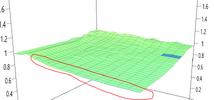
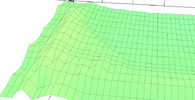
Well, I can understand why @Crazycanadian would combine the VE and VVT table because if you actually look at them separately, they fill the gaps to make one smooth table. For example, above 5500RPM the VE table has a weird increase of efficiency, although the engine would rather be loosing efficiency at higher RPM. Then, if you look at the VE VVT table at the same point, it actually removes this engine efficiency, which makes sense. But the problem is most people 0 out VVT pretty much above 5500RPM, rather on the stock tune it has 4* of VVT to redline. So what happens is the main VE no longer gets corrected by the VVT VE which means it doesn't have this (realistic) change. Not sure if that makes sense but I'll show you a visual difference.

VE TABLE BEFORE COMBINING
1788256346287.png

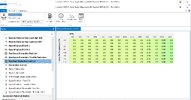
VE TABLE AFTER COMBINING
1788256473307.png
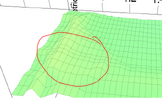
There is a clear difference. If you follow the lines, before they were jumpy and now combined you can see how they come together to generate a much smoother change, more obvious where I marked it in red which is the 2.0 load axis with RPM increasing to the right which is what I'll be tracking on a WOT run.

Another example, this is a MPS 3 GEN 1 VE table., here is the before.

1788256691416.png

Here is the after
1788256739381.png

Massive difference. I don't know why Mazda did this, but I can understand why combining them may produce a better result.

Maybe combining the main VE and VVT VE table AFTER 5500RPM might make sense because no one uses VVT near redline and this may provide a smoother main VE table during higher RPM high boost scenarios.
 
1. Dunno, lunched the motor before I found out. Might even still be an issue.

2. Well, stops VVT from being safely used. Basically what you've done when you mixed the tables is you've told it a situation exists when it doesn't. The VE curve will change depending on a fair number of factors, but VVT actuating actually changes it directly; since you aren't compensating for what the VVT is *actually* doing, and instead relying on what you've seen in specific conditions, anything outside of those conditions is a guess and is likely to cause weird shit to happen with regards to fueling calculations.

3. Oh it absolutely does, but limits fucking with measured results is what I would consider a bug with the code. It should read what the formula spits out, regardless of what else is going on; it doesn't, however, and that load calc can change based on other corrections taking place to try and limit it. It's kind of similar to how the ECU tries to find MBT for cruise by registering ghost knock to see if things change with fuel consumption (this is an assumption on what it's doing, but also the only one that makes sense, unless its some kind of Toyota level emissions cheat).

I've play with the VE and VVT tables quite a bit. I understand what you are saying in theory, but in practice I haven't seen an issue with it. The VVT table adjustments are quite small. It's not hard to combine the tables, make edits and then seperate them afterwards.

Have you played with the OBD J197 standard formulas for Calculated load and Absolute load? I am not sure we are on the same page when I mention Calculated Load vs Absolute Load. I am not sure what you are getting at when you mention a bug with the code.
 
Bug regarding load targeting is documented here:
I could probably find the load formula again but if memory serves its probably the SAE one that involves airflow, rpm and displacement or somesuch. It wasn't a complicated formula.
 
I may be wrong, but I believe the load targeting bug was resolved not too long ago. There was a 1D displacement map on VT and it never use to do anything. I remember that VT released an update on the Mazdaspeed's and I saw it had a mention of a new displacement table. When I changed the displacement it completely changed the load readings and MAF curve had to be retuned. This was back when I was on a 2.5L engine and experimenting, but it seems like you never resolved your problem when I read your thread? Maybe it now has been?
 
Bug regarding load targeting is documented here:
I could probably find the load formula again but if memory serves its probably the SAE one that involves airflow, rpm and displacement or somesuch. It wasn't a complicated formula.
I've gotta go take some logs. Looks like all the good information and testing was done behind closed doors and not openly shared. I don't see what the results of the VE testing was other then it didn't fix your load cap issue.
 
I said in the thread that I couldn't make it work. I must have done dozens of logs making small changes to one table, testing, then another table, testing and just chasing my tail the whole time.
 
Well update.. I have changed the ignition coil packs and SO FAR I have not had any hesitations. I am glad to say the problem, form now, is fixed.

Now an off topic question, does anyone understand the logic behind how the stock ECU controls ignition timing during idle? I see on VersaTuner the idle ignition adjustments table, but they don't apply at idle as they do in the table, at least from what I have seen.

So far from what I can tell the car when it is idling will start with 10* of ignition timing. Then it will reference the ignition adjustments table as a + or -. So if the table has 5, it will do 10* + 5* resulting in 17*. Where does it get this base number of 10*, because it most certainly is not from the ignition maps.

Now the reason I am asking this is something people do, common on standalone ECUs, is they fluctuate ignition timing at idle to generate a cam sound. I know I know, you may hate it or you may love it, but besides the point I was wondering if there was anyway to achieve this on our stock ECU? And yes, I have tried changing the ignition adjustments table and it did not work. I did anything above idle target RPM it -30* to force it to drop and then anything on target or below target will be 10* to get it to jump up, but the car does not do this and it manages to find a way to idle steady.

I attached a video of someone who is on a standalone ECU and achieved this sound.
 

Attachments

It's either a closed loop system that looks only at RPM, or the tables have not been unlocked as of yet. Best bet is to ask this on the VT forums.
 
Back
Top